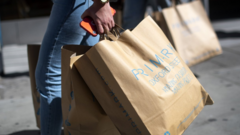
Primark has said it plans to launch a home delivery service in Britain, four years after it made its first foray into e-commerce.
The retailer did not say when it expects to launch the service, but it has bought a warehouse in Sheffield from to enable it to ship products to homes.
The company said there was “opportunity for profitable growth” through home deliveries, which could help boost trade after Primark reported subdued sales following the recent hot weather.
Analysts said the decision to offer home delivery after years of resistance – including through the pandemic – indicated that Primark was facing major challenges from ultra-fast-fashion brands such as Shein.
Primark did not sell goods online until 2022, when it launched a click-and-collect service which meant shoppers still had to travel to pick up their purchases.
Associated British Foods (ABF), which owns Primark, said the fashion chain would “continue to grow click and collect and… will in the future offer home delivery in Great Britain”.
ABF predicts Primark’s UK sales will grow by about 1% in the fourth quarter of the year. But like-for-like sales – a key metric in the retail industry, which strips out the impact of store openings and closures – are expected to be “broadly flat” in the UK, and fall 3% across its global operations.
It said sales of autumn/winter clothing started later than normal due to the hot weather in the summer, but “trading was stronger when the weather cooled towards the end of the quarter”.
The fast-fashion chain is struggling to compete with brands such as Shein and Boohoo, as well as alternative platforms such as TikTok Shop and Vinted, and in July said it was lowering prices on hundreds of clothing items.
Retail analyst Julie Palmer said that “Primark has been playing catch up for years” and launching home deliveries “is as much about defence as growth”.
She told BBC News that “the real test” for the brand is whether it can make home deliveries profitable at the low prices customers have come to expect from fast fashion chains.
“Shein and Vinted have already reset customer expectations on convenience,” she said, adding that a “slick and effective returns policy” will also be key.
ABF is planning to spin off Primark from its food business next year.
Retail analyst Natalie Berg said Primark was “more than fashionably late to the e-commerce party”.
She said the brand will need to absorb additional costs of returns, which tend to be higher than in-store purchases as customers cannot try clothes on before buying them.
“Not even the pandemic could convince them to launch online, so the fact that Primark is making such a U-turn tells us just how much the retail landscape has evolved,” she said.
Dan Coatsworth, head of markets at AJ Bell, said that thanks to greater competition among delivery firms such as InPost and Relay, “it’s become a lot cheaper in the past few years to send items by post, compared to the old days when Royal Mail dominated the market”, he added.
Retailers across the UK are grappling with higher costs for labour and energy.
On Thursday, John Lewis – which operates the department stores and Waitrose supermarkets – reported that its half-year losses had widened to £124m from £88m a year earlier.
Chairman Jason Tarry said the results reflected the partnership’s “continued investment in our transformation, a more challenging trading environment and the increased costs of doing business”.
Sales in the department store arm of the business fell 2%, as it said consumers were holding back on discretionary spending.
Waitrose sales were up 4%, but profits slipped slightly which the company said was due to a decision to lower prices and also reflected “the extra cost of running our operations through the heatwaves”.