An air traffic control failure that sparked widespread travel chaos earlier this month was caused by a “software defect” affecting the system underpinning UK air space management, the national air traffic service Nats has said.
The problem happened “in the space of a millisecond”, Nats said, leading to the system producing corrupted data.
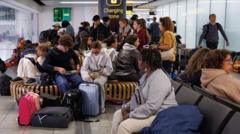
The failure led to more than 2,000 flights being cancelled and hundreds of thousands of passengers affected, with some sleeping on airport floors or getting stuck overseas.
Transport Secretary Heidi Alexander called the disruption “completely unacceptable”, while industry body Airlines UK is writing to Nats to demand immediate compensation for costs incurred.
The incident prompted questions over the resilience of Nats’ systems, and some airlines questioned the position of its chief executive Martin Rolfe.
There has also been anger from passengers about how much support they got from airlines, and about the fact that they are unlikely to be entitled to compensation because the regulator judges the situation was extraordinary circumstances.
In an initial report, external, Nats said the software defect meant air traffic controllers had reduced information available, so restrictions were put in place to limit air traffic to maintain safety.
The defect occurred at 10am on 8 September, but staff did not realise there was a serious problem for another two and a half hours.
The system restart did not start until just after 3:15pm, and restrictions on UK airspace were not lifted until 7:30pm.
Flights in and out of the UK’s main airports were affected, including Heathrow, Gatwick, Luton and Glasgow.
The disruption took days to completely resolve because of the number of planes and crew left out of place.
Martin Rolfe said: “I would like to apologise again, very sincerely, to everyone who was affected last week.
“It’s our job to get people where they want to go, quickly and without delay and we are devastated when that goes wrong.
“However, our primary role is to keep our skies safe, and everyone who flies through them. At no point last week was safety in question.”
The government had previously ruled out a cyber attack, and last week the Ministry of Defence denied a report that a military aircraft was to blame.
Reacting to the Nats report, the transport secretary described the disruption as “completely unacceptable” and “frustrating” for passengers, airlines and airports.
“It’s clear we need to urgently understand why this issue was not discovered and fixed before it caused chaos,” Alexander said, adding that a Civil Aviation Authority review was underway.
Tim Alderslade, chief executive of Airlines UK, said: “Once again, it is passengers who have suffered and airlines who have picked up the pieces – and the tab – of an ATC [Air Traffic Control] system failure, while Nats itself faces no real consequences.”
He added that passengers deserved “commitment and proof that the system is being fixed”.
Alderslade also said Airlines UK was writing to NATS “to demand immediate compensation for the costs incurred and a credible plan to improve resilience.”
He added that the forthcoming Civil Aviation Bill needed to “look closely at the question of redress to put an end to airlines being left yet again as the insurer of last resort”.
Addie Kitson, 26, had been on a solo-holiday in China when her flight home from Chengdu was diverted to Sweden.
“I thought I landed fine” she told the BBC, “but then they went: ‘Welcome to Stockholm’ I went: ‘Ooh, that’s not London'”.
After being told about the issues affecting UK airspace, they were kept on the plane for a few hours, and then spent 19 hours inside Stockholm airport.
“I got one £11 food voucher that didn’t even cover the cost of a sandwich in Stockholm airport”, Addie said.
She had to buy all refreshments, plug adaptors and WI-FI connections so she could work remotely in the airport because she had not made it home to get back for work. It was almost £100 in unexpected costs.
Addie questioned the rules around compensation.
“I saw an update saying if you were delayed, diverted or cancelled because of these issues you didn’t get any compensation because it was an extraordinary event,” she said.
“It’s happened multiple times before, it doesn’t seem that extraordinary.”